

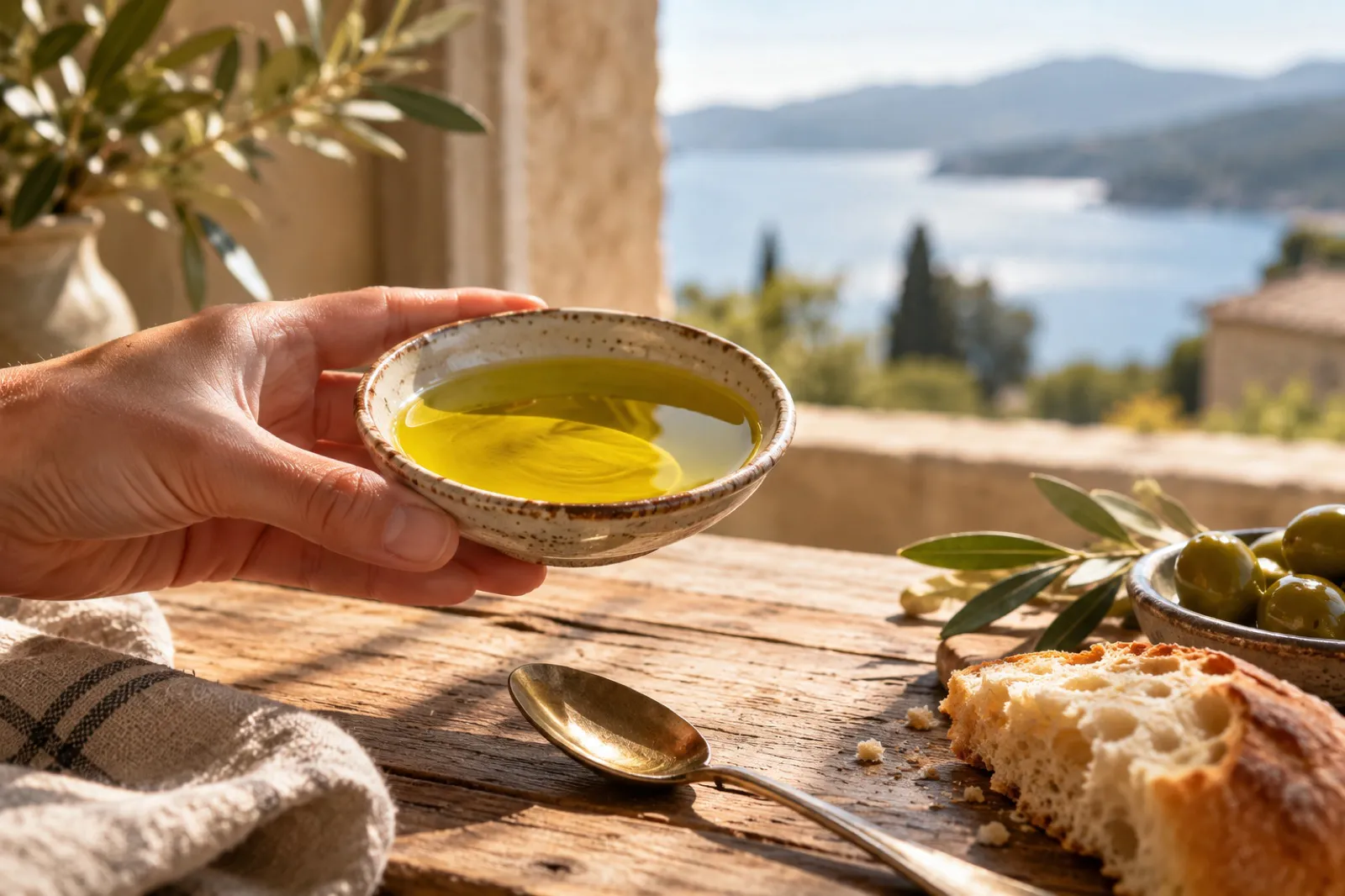
Olive oil rarely announces that it has gone off. There is no fizz, no mould, no sour smell like old milk. It just slowly loses what made it worth buying, until one day the salad tastes of nothing and the pan smells faintly of crayons. The good news is that you can check in a couple of minutes, with nothing but a small glass and your senses.
Why olive oil goes off at all
Olives are a fruit, and olive oil is extracted from that fruit, much like a juice. Like any fat, it reacts with oxygen, and light and heat speed that reaction up. The result is oxidation, and in its later stages, rancidity. Rancid oil is not something you want on your food. It tastes stale and flattens everything it touches.
Once the oil is made, three things largely decide how fast this happens: how old the oil was when you bought it, how it was stored before it reached you, and how you store it now. You only control the last one, but you can check the result of all three.
The two-minute check
- Pour a little into a small glass or onto a spoon. About a tablespoon is plenty.
- Warm it. Cup the glass in your hand for a minute, with your other hand over the top. Warmth releases the aroma.
- Smell it. Fresh extra virgin oil smells green or fruity: cut grass, green apple, tomato leaf, artichoke, almond. It depends on the olives and the harvest. What you do not want is a smell of crayons, putty, old walnuts or the cardboard inside a cereal box. Those are the classic signs of rancid oil.
- Taste it. Sip a little and pull some air through it across your tongue. Good oil tastes clean. Many fresh oils have some bitterness on the tongue and a peppery catch at the back of the throat, sometimes strong enough to make you cough. In professional tasting, bitterness and pungency count as positive qualities, not faults.
- Notice the finish. Does the taste fade cleanly, or does it leave a greasy, stale coating? Stale and greasy points to old oil.
Other faults worth knowing
Rancidity is the most common problem in a home kitchen. Tasters name a few other faults, which usually start at the mill or in storage, before the oil ever reaches you:
- Fusty or muddy: a heavy, fermented smell, from olives left in a heap too long before milling, or oil left sitting on its sediment.
- Musty: mouldy and earthy, like a damp cellar.
- Winey or vinegary: sharp and sour, like wine that has turned.
To be graded extra virgin, an oil must be judged free of defects by a trained tasting panel. If you can clearly smell one of these faults, the oil in your glass is unlikely to meet that grade any more, whatever the label says.
What does not tell you much
Colour. Olive oil ranges from pale gold to deep green, depending on the olives and when they were picked. Colour says little about quality or age. Professional tasters use dark coloured glasses, usually blue, so the colour cannot influence them.
Cloudiness after the cold. Olive oil turns cloudy and can partly solidify in a cold kitchen or a fridge. Bring it back to room temperature and it clears. That is normal, not a fault.
The best-before date on its own. It is set by the bottler and usually counts from bottling, not from harvest. An oil can be well inside its date and already tired. The harvest date, if the label has one, is the more useful number.
Keep it good for longer
- Store it somewhere dark and cool, away from the hob and the oven. The shelf above the cooker is the worst spot in the kitchen.
- Keep the cap on. Every minute the bottle sits open, air gets in.
- Buy a size you will finish. Once opened, aim to use a bottle within a couple of months. A bottle you finish quickly beats a big tin that sits open for a year.
- Do not decant it into a clear glass cruet on the windowsill. It looks lovely, and the light slowly ruins the oil.
If your oil fails the test
Do not cook with it. Heat will not fix the flavour, and the stale taste will carry into the food. Do not pour it down the sink either, as oil clogs drains. Check how your local council wants cooking oil disposed of.
Then, next time, buy with the harvest date in mind. Every Dukat bottle carries its harvest date and a batch code, and you can look up your batch to see what we recorded for it. It is the simplest way to know what you are pouring.