

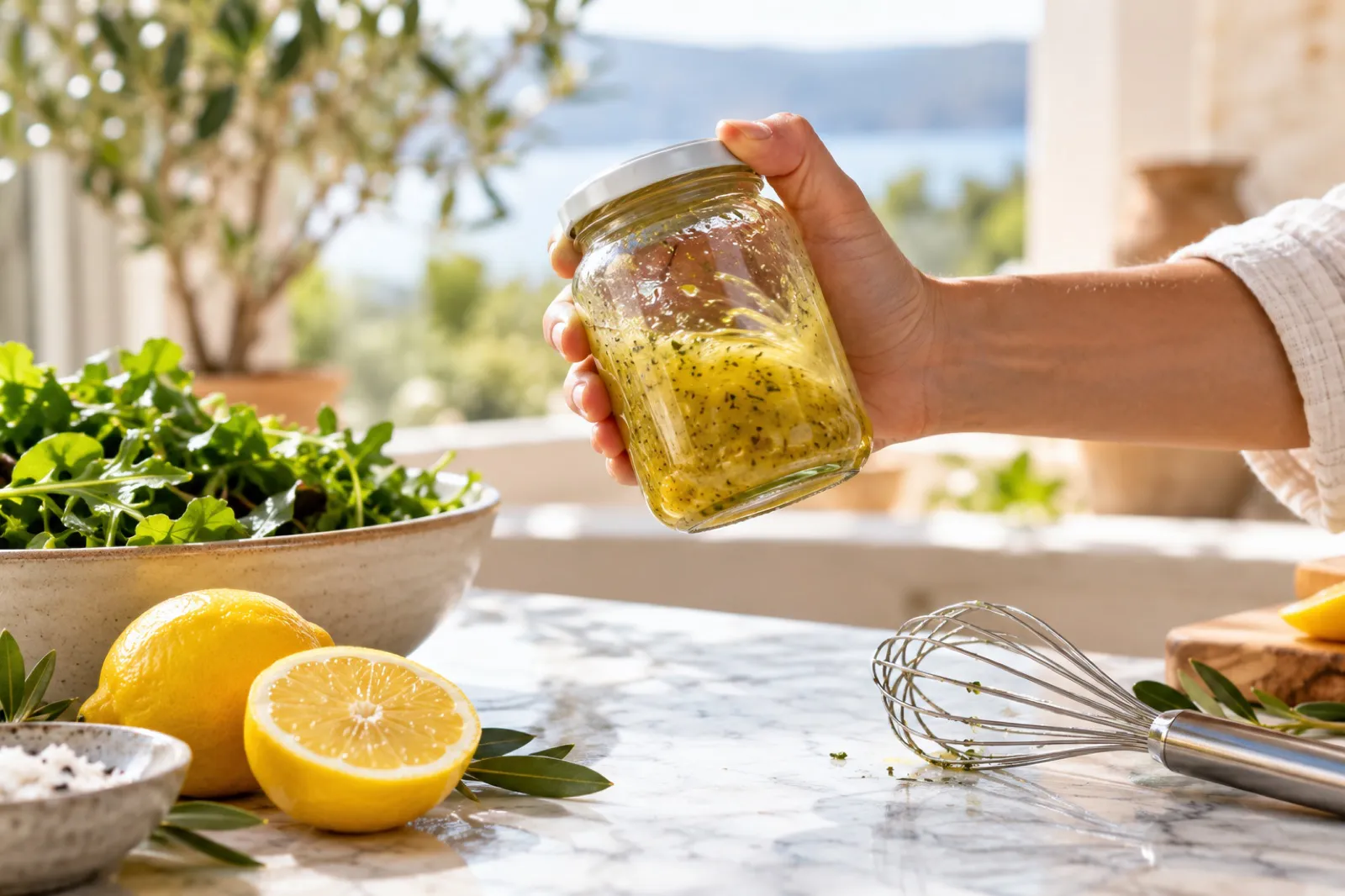
Most people buy salad dressing because they think making it is a project. It is not. A good lemon and olive oil dressing takes two minutes in a jar, keeps in the fridge, and goes on far more than salad. Once you have the ratio in your head, you will stop needing a recipe at all.
The ratio
Three parts oil to one part lemon juice. That is the whole secret. It is a starting point, not a law: some people like it sharper, at two to one, and some like it softer, at four to one. Start at three to one and adjust to taste.
The recipe
Makes about 120 ml, enough for four or five salads.
- 90 ml (6 tbsp) extra virgin olive oil
- 30 ml (2 tbsp) lemon juice, from about 1 lemon
- 1 tsp Dijon mustard
- Half a tsp fine salt
- Black pepper
- Optional: half a tsp honey, 1 small garlic clove finely grated
- Put the lemon juice, mustard, salt and any honey or garlic into a clean jam jar. Stir with a fork so the salt starts to dissolve.
- Pour in the oil and add a few turns of pepper.
- Put the lid on and shake hard for 15 seconds, until the dressing turns cloudy and slightly thick.
- Taste it on a leaf, not off a spoon. Add more salt, lemon or oil until it tastes right on the food.
Why each part is there
Salt goes in with the lemon. Salt dissolves in water and lemon juice, not in oil. Add it first and it disappears into the dressing. Add it last and it sits as grains.
Mustard holds it together. Oil and lemon juice separate. A teaspoon of mustard helps them stay mixed for longer, and gives the dressing a little body. You will barely taste it.
Honey is optional. It rounds off the sharpness of the lemon. Leave it out if your salad already has something sweet in it, like fruit or roasted squash.
The oil carries the flavour. In a raw dressing, nothing cooks the oil, so you taste it just as it is. A fresh, green or fruity oil makes a dressing that tastes alive. A tired one makes a dressing that tastes of very little.
Where to use it
- Any leaf salad, dressed just before serving
- Warm new potatoes, dressed while still hot so they soak it up
- A bowl of cooked lentils, chickpeas or white beans
- Grains such as bulgur, farro or couscous
- Roast vegetables, straight out of the oven
- Grilled or pan-fried fish and chicken
- Steamed green beans, broccoli or asparagus
Five ways to change it
- Herby: stir in 2 tbsp finely chopped parsley, dill, mint or chives.
- Creamy: shake in 2 tbsp plain yogurt. Good on cucumber, potatoes and grilled meat.
- Sharper: swap half the lemon juice for red or white wine vinegar.
- Shallot: add 1 tbsp very finely chopped shallot and let it sit in the lemon juice for 10 minutes before adding the oil. The lemon takes the harsh edge off.
- Zesty: add the finely grated zest of the lemon you juiced, for more lemon flavour without more sourness.
Storing it
Keep the jar in the fridge and use it within a few days. If you want it to keep longer, leave out the garlic and fresh herbs and add them to each portion as you use it.
Do not worry if the dressing goes thick and cloudy in the fridge. Olive oil can partly solidify at fridge temperature. Take the jar out 15 minutes before you need it, or run it under warm water for a moment, then shake again.
How much to use
Less than you think for leaves, more than you think for everything else. Delicate salad leaves need about 1 tbsp of dressing per two handfuls, tossed with your hands so every leaf is coated without going limp. Potatoes, beans and grains soak dressing up, so add it in stages and taste as you go.
Dress leaves at the last moment. Dress beans, grains and potatoes while warm and up to an hour ahead: they get better as they sit.
A dressing like this goes through oil steadily, a few spoonfuls at a time, week after week. If that sounds like your kitchen, our olive oil subscription sends extra virgin olive oil from Dukat, in Albania’s Vlorë county, so the jar never has to wait for a shopping trip.