

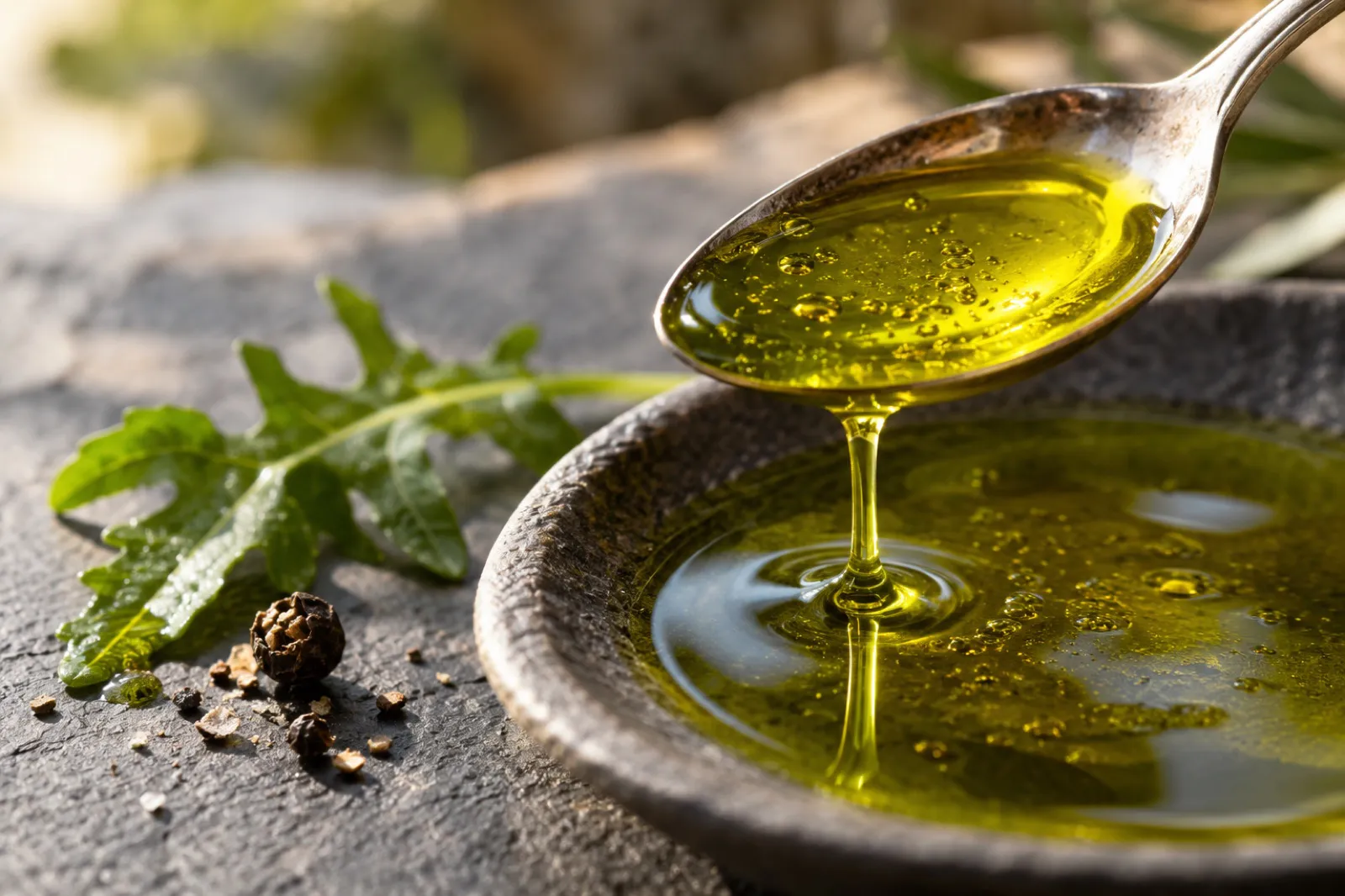
You taste a spoonful of olive oil on its own. It starts smooth and fruity. Then, a second or two after you swallow, something catches at the back of your throat. A tickle, a sting, maybe a cough.
The first time it happens, plenty of people assume something is wrong with the oil. Usually the opposite is true.
It has a name: pungency
Professional olive oil tasters call this sensation pungency. On labels and tasting notes it often appears as “peppery”. It is one of three positive qualities that tasting panels look for in extra virgin olive oil, alongside fruitiness and bitterness.
Pungency is not the same as bitterness. Bitterness is a taste, felt on the tongue. Pungency is a sensation, felt in the throat. An oil can be quite bitter and gently peppery, or the other way round.
Where it comes from
The sting comes from natural compounds that are in the olive fruit and carry over into the oil. Researchers have traced much of it to one compound in particular, called oleocanthal.
The reason you feel it in your throat and not on your tongue is simple anatomy. The receptors that respond to this compound sit mainly in the throat rather than on the tongue, so that is where the tickle lands, a moment after you swallow.
Why some oils bite and others do not
How peppery an oil is depends on a few things:
- When the olives were picked. Greener, earlier-harvested olives generally give oil with more bitterness and more pepper. Riper fruit gives softer oil.
- The olive variety. Some varieties are naturally punchier than others.
- How fresh the oil is. This is the big one for you as a buyer.
Why it fades
The compounds behind the pepper break down over time, especially with exposure to light, heat and air. A very peppery oil in the first months after harvest will be noticeably gentler later on.
This is why an oil that does not catch your throat at all is not necessarily a bad oil, but an oil that once did and no longer does has aged. It is also why oil that has spent a long time in warehouses and on bright shelves can taste of very little: by the time it is opened, much of the bite has gone.
So the sting is a useful freshness clue. Not proof on its own, but a good sign.
How to taste for it
- Pour a spoonful of oil into a small glass.
- Cup it in your hand for a minute to warm it slightly.
- Take a small sip and draw some air in through your teeth to spread it around your mouth.
- Swallow, and wait. The catch usually arrives a second or two later.
Notice how strong it is and how long it lasts. A gentle warmth that fades quickly is a mild oil. A sting that makes you cough is a robust one. Tasters sometimes describe oils as “one-cough” or “two-cough”, half joking.
What if you do not like it?
That is fine. Plenty of people find a strongly peppery oil too much on its own. A few things help:
- Taste it on food, not alone. On bread, beans, potatoes or grilled vegetables, the pepper softens into the background and adds a bit of warmth.
- Pair it with things that can take it. Bitter leaves, tomatoes, lentils, grilled meat and strong cheeses stand up well to a punchy oil.
- Cook with it. Heat mellows both the bitterness and the pepper.
- Give it a few tastes. Many people who flinch at the first peppery oil end up missing the bite when they go back to a flat one.
The short version
The catch in your throat is pungency. It comes from natural compounds in fresh olives, it is something tasters actively look for, and it fades as oil ages. If your oil has it, that tells you something about how fresh it is.
Pair the sting with a harvest date and you know a lot more. Every Dukat bottle carries both a harvest date and a batch code, and you can look up your batch here to see when your oil was made.