

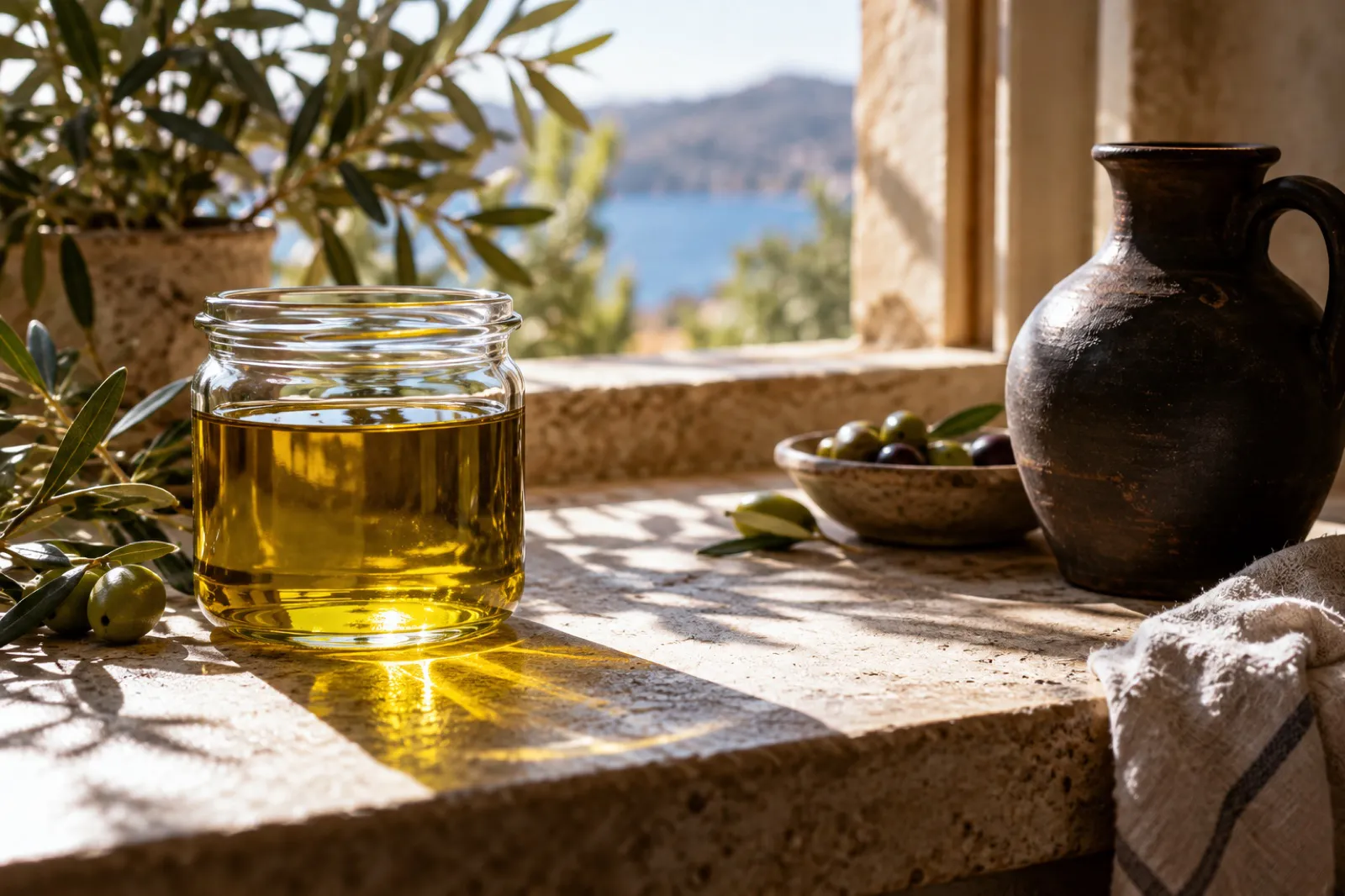
Walk down a supermarket aisle and you will see olive oil in every kind of container: clear glass, green glass, plastic, tins, even boxes with a tap. It can look like a design choice. It is not. The container is one of the first things that decides how the oil tastes when it reaches your kitchen.
Three things ruin olive oil
Olive oil has three enemies: light, heat and air. All three speed up oxidation, the slow chemical change that turns a fresh, green oil into a flat, stale one. Good packaging deals with light and air. Heat is mostly up to the shop, the courier and you.
Light: the problem with clear glass
Light, including ordinary shop lighting, drives oxidation in olive oil. Fresh extra virgin oil contains chlorophyll, the green pigment from the olive, and chlorophyll makes the oil more sensitive to light. So a fresh, green oil has a lot to lose on a bright shelf.
Clear glass lets most visible light through. It shows off the colour, which is why it is popular, but the oil pays for it. A bottle that spends weeks under shop lights can start to lose its freshness before anyone opens it.
Dark glass, usually deep green, brown or near black, blocks much of the light. Tins block it completely, and so does a bag-in-box, with the bag sealed inside its carton. That is why producers who care about freshness tend to use one of those three.
Air: why the closure and the size matter
Every container lets air in once it is open, and some let a little in even when closed. Plastic lets more air through over time than glass or metal, which is one reason glass and tins are the usual choice for oil that has to keep.
Size matters too. Every time you pour, air takes the place of the oil you poured. A large container that sits half empty for months exposes the oil to more and more air. A bottle you finish in a few weeks avoids most of that.
Tins, dark glass and bag-in-box
- Tins block all light, are lighter to ship and do not break. They suit larger quantities. Decant a little at a time into a small dark bottle for daily use, so the tin can stay closed.
- Dark glass blocks most light, does not let air through, and is easy to pour from. It is the usual choice for a bottle that lives near the cooker or on the table.
- Bag-in-box blocks light, and the bag collapses as you pour, so less air gets in. It is practical for kitchens that go through a lot of oil.
Packaging only works if storage does too
The best container in the world will not save oil that lives next to the hob. Heat does damage that dark glass cannot stop. Once you get a bottle home:
- Keep it in a cupboard, away from the cooker, the oven and sunny windows.
- Close the cap after every use.
- Skip the clear cruet on the windowsill. If you like a pourer, choose a dark or opaque one and refill it little and often.
- Skip the fridge too. Cold makes olive oil cloudy and thick. It clears again at room temperature, but it is a nuisance to pour.
What to look for when you buy
- Dark glass, a tin or a bag-in-box. Pass on clear glass, however pretty.
- Where the bottle has been sitting. Bottles at the back of the shelf, out of direct light, have likely had an easier time than those at the front under the lamps.
- A size you will finish within a couple of months of opening.
- A harvest date, so you know how old the oil was before the packaging started protecting it.
Buying online removes the shelf from the picture, but not the questions. Look closely at the product photos. If the oil is shown in a clear bottle glowing in the sun, that is probably how it is packed. If you are not sure, ask.
Our bottle
Dukat oil comes in a 0.5 L dark glass bottle, a size you can realistically finish within a couple of months of opening. Each one carries a harvest date and a batch code. You can see the bottle in the shop, on its own as The Bottle or in The Pair and The Case.