

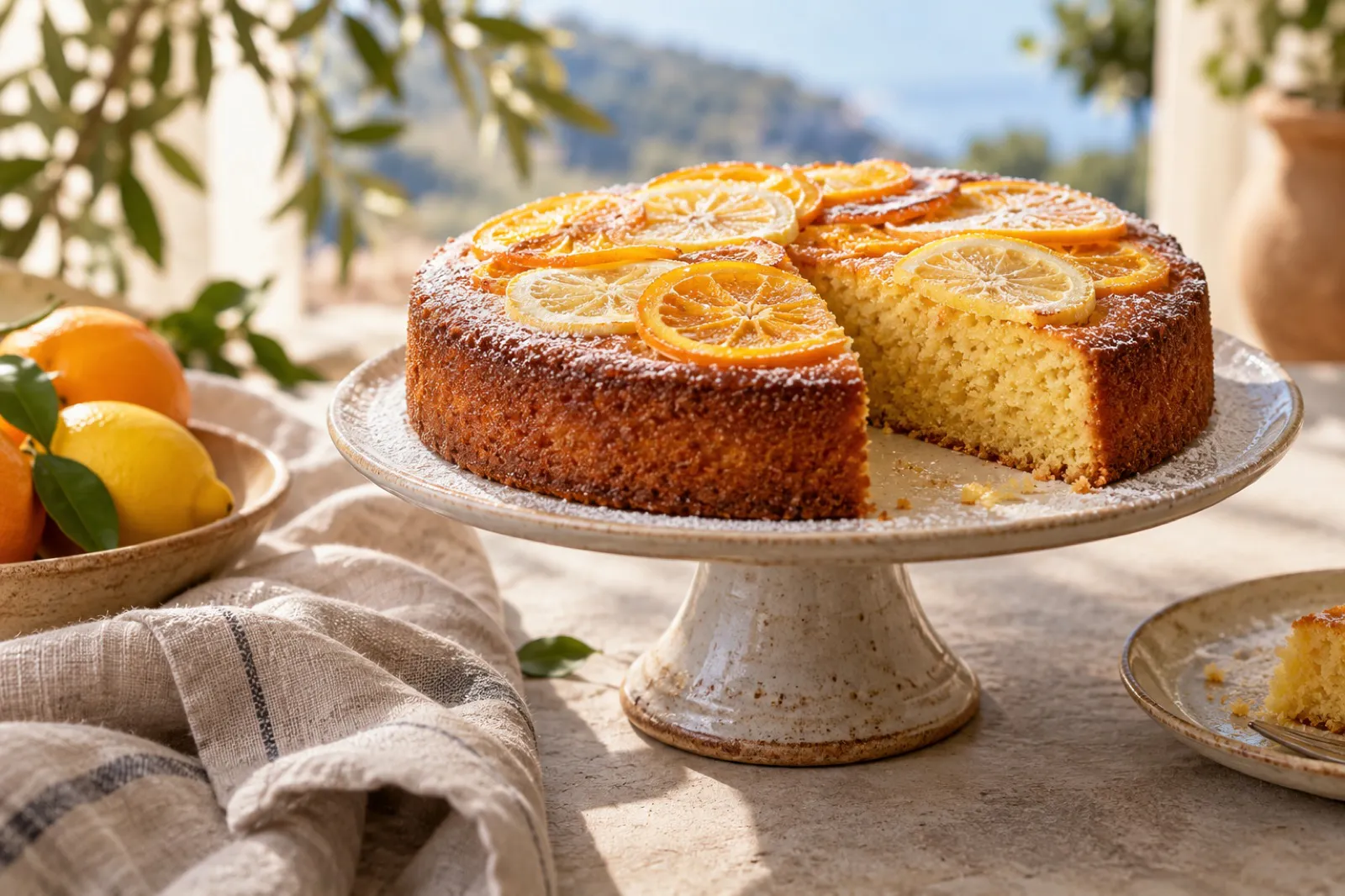
Olive oil cake has a reputation for being unusual. It is one of the easiest cakes you can make. There is no butter to soften, no creaming, and no stand mixer needed. You whisk, you pour, you fold, and you bake. The result is moist, fragrant and keeps for days.
Why bake with olive oil
Texture. Butter is solid at room temperature, so butter cakes firm up as they cool. Oil stays liquid, so an oil cake stays soft and tender. That is why olive oil cakes often taste better on day two than on day one.
Flavour. A neutral oil adds moisture and nothing else. Extra virgin olive oil adds moisture and a gentle fruity, green note that sits beautifully with citrus. In the finished cake it is subtle: people tend to notice that the cake tastes good before they notice the oil.
Ease. Everything happens in one bowl with a whisk. If you can make pancake batter, you can make this.
Which oil to use
Use an extra virgin olive oil you would happily taste on its own. A bright, fruity oil will show up as a pleasant background note. A very bitter or very peppery oil will show up a little more, which some people love. A stale oil will make the cake taste stale, so taste a spoonful before you start.
Citrus olive oil cake
Makes one 20 cm round cake, about 10 slices.
- 3 large eggs, at room temperature
- 180 g caster sugar
- Finely grated zest of 2 oranges and 1 lemon
- 150 ml extra virgin olive oil
- 120 ml orange juice, from the zested oranges
- 220 g plain flour
- 2 tsp baking powder
- A quarter tsp fine salt
For the glaze (optional):
- 100 g icing sugar
- 2 tbsp lemon juice
Method
- Heat the oven to 180°C, or 160°C for a fan oven. Oil a 20 cm round cake tin and line the base with baking paper.
- Put the sugar and all the citrus zest into a large bowl and rub them together with your fingertips for a minute. The sugar will turn damp and fragrant.
- Add the eggs and whisk for 3 to 4 minutes, by hand or with an electric whisk, until the mixture is pale and slightly thickened.
- Keep whisking while you pour in the olive oil in a slow, steady stream. Then whisk in the orange juice.
- In another bowl, mix the flour, baking powder and salt. Sift or tip them into the wet mixture and fold gently with a spatula until there are no dry streaks. Do not overmix.
- Pour the batter into the tin and bake for 40 to 50 minutes, until golden on top and a skewer pushed into the centre comes out clean. If the top browns too fast, cover it loosely with foil for the last 10 minutes.
- Leave the cake in the tin for 15 minutes, then turn it out onto a rack to cool completely.
- For the glaze, stir the icing sugar and lemon juice together until smooth and pourable. Spoon it over the cooled cake and let it run down the sides.
Getting it right
- Room temperature eggs whisk up with more volume, which gives a lighter cake. Put cold eggs in a bowl of warm water for 10 minutes if you forgot to take them out.
- Rubbing the zest into the sugar releases the oils in the peel. It is the step that makes the cake taste of oranges rather than just being sweet.
- Pouring the oil slowly helps it blend evenly with the eggs, so the cake does not turn out greasy at the bottom.
- Folding gently keeps the crumb tender. Stop as soon as the flour disappears.
Variations
- All lemon: use the zest of 3 lemons and replace the orange juice with 60 ml lemon juice plus 60 ml milk.
- Blood orange: in winter, use blood oranges for the zest and juice. The glaze turns pink if you make it with blood orange juice instead of lemon.
- Almond: replace 50 g of the flour with 50 g ground almonds for a richer, slightly denser crumb.
- Syrup soaked: skip the glaze. Warm 3 tbsp orange juice with 2 tbsp sugar until dissolved, poke holes in the warm cake with a skewer, and spoon the syrup over.
Serving and storing
Serve it as it is, or with a spoonful of thick yogurt or crème fraîche and a few slices of fresh orange. For something a little different, pour a thread of olive oil over each slice and add a few flakes of salt.
Wrapped well or kept in a tin, the cake keeps at room temperature for 3 to 4 days. Unglazed, it also freezes well in slices for up to a month.
Baking beyond cake
When a recipe for muffins, banana bread or brownies calls for a neutral vegetable oil, you can usually swap in the same amount of extra virgin olive oil. Swapping it for butter takes more care, so start with recipes written for oil.
Our extra virgin olive oil comes from Dukat, a village in Vlorë county, Albania, between the mountains and the sea. A cake like this, wrapped and given with a bottle of the oil that made it, is a good present. The Pair makes that easy: one bottle to give, one to keep.