

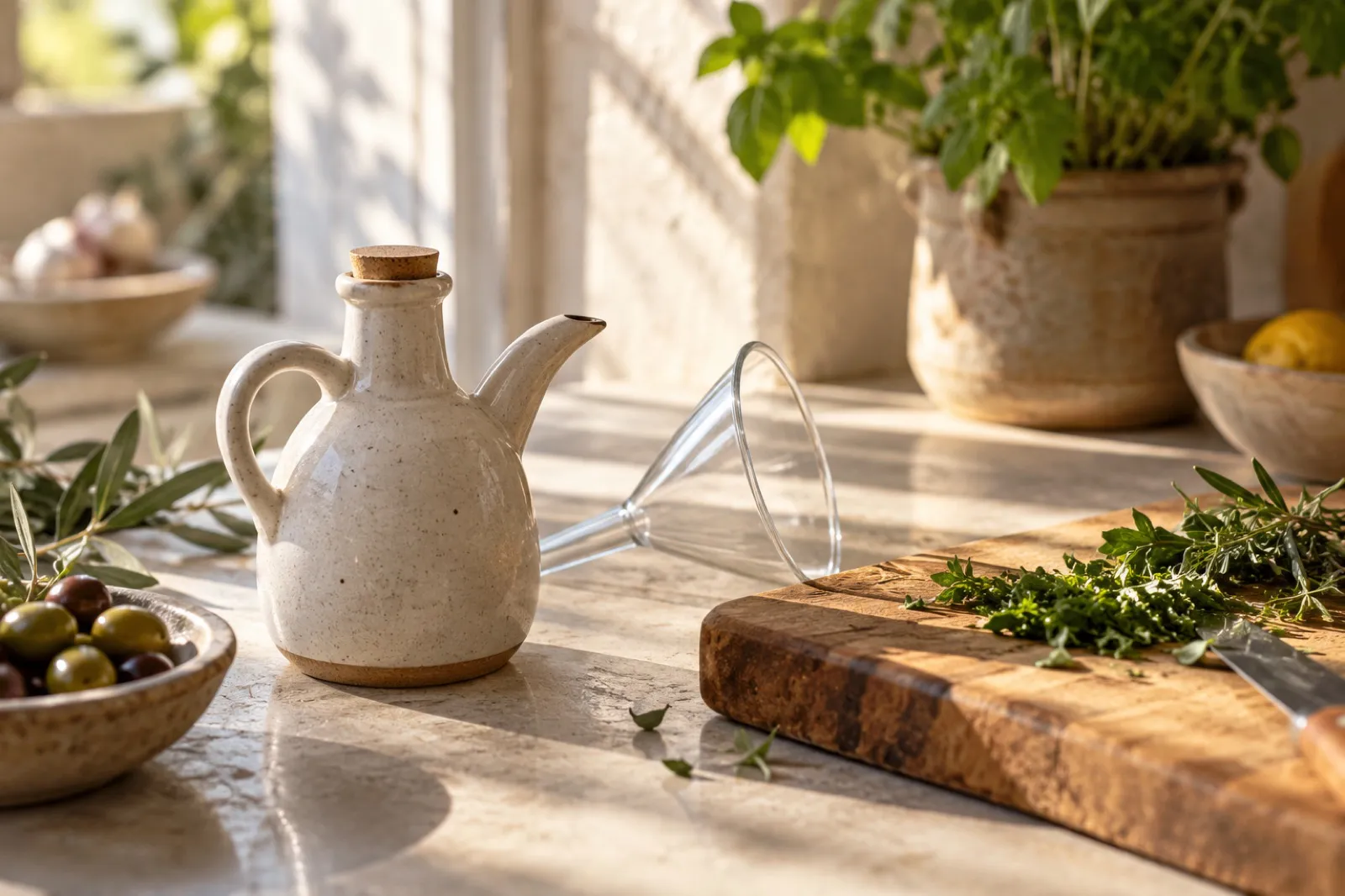
Most people do not pour olive oil straight from the bottle they bought. They decant it into a cruet, fit a pourer, or keep a refillable bottle by the hob. It makes cooking easier. Done carelessly, it also makes the oil go stale faster.
None of this is complicated. A few small habits keep the oil in your pourer tasting like the oil in your bottle.
Why decanting can go wrong
Olive oil has three enemies: light, heat and air. Decanting can expose it to all three at once:
- Pretty clear-glass cruets let in light.
- Pourers left open let in air all day.
- The counter by the hob is the warmest spot in the kitchen.
- Topping up an old container mixes fresh oil with stale oil.
Fix those four and you are most of the way there.
Choosing a container
Go opaque. Stainless steel, glazed ceramic, tins or dark glass all block light. Clear glass looks lovely and shows off the colour, but it is the worst option if the container lives out in the room.
Go small. A container that holds about a week or two of cooking means the oil is used before it has time to fade. A big decanter that takes a month to empty defeats the point.
Look for a closure. A pourer with a flip cap, a hinged lid or a stopper keeps air and dust out between uses. Open-spout pourers are fine for a dinner party. For everyday use, pick one you can close.
Make sure it comes apart. You need to be able to wash and fully dry it. Narrow necks that hold on to old oil are a problem.
Pourers in the original bottle
Fitting a pourer into the bottle you bought is often the simplest choice, especially if the bottle is already dark glass. A few tips:
- Pick a pourer with a cap or flap, and close it after use.
- Check the seal fits snugly in the neck so air is not getting in around the sides.
- Wash the pourer between bottles. Old oil dries into a sticky film inside the spout and goes rancid there.
How to refill properly
The single most common mistake is topping up. Pouring fresh oil on top of the last centimetre of old oil means the old oil, which has been exposed to air longest, now flavours the new.
- Use it up. Let the container run empty, or close to it.
- Wash it. Warm soapy water. A bottle brush helps with narrow necks.
- Dry it completely. Leave it upside down to air dry for a day if needed. Water left inside can spoil oil.
- Refill a small amount. Enough for the next week or two, not the whole bottle.
- Put the main bottle back in the cupboard. Cap on, out of the light.
Where to keep the decanter
Close enough to use, far enough from the heat. A spot at the side of the counter, away from the hob, oven and window, is ideal. If you only have a spot right by the cooker, keep less oil in it and refill more often.
A two-container system
A setup that works well in most kitchens is simple:
- The working container: a small, opaque, capped pourer on the counter, holding a week or two of oil.
- The reserve: the original bottle, sealed between refills, in a dark cupboard.
The reserve stays protected. The working oil turns over fast. You get convenience without paying for it in flavour.
What about refill schemes and big tins?
Refilling from a large tin or a shop’s bulk dispenser can be a good way to cut down on packaging. The same rules apply: clean and dry your container, do not top up stale oil, and keep the bulk supply sealed, cool and dark between refills. Large tins are a bigger commitment, since the tin is opened and closed many times before it is empty.
Know what is in the bottle
Decanting has one downside: the label stays behind. Before you pour the bottle into anything else, it is worth noting the harvest date somewhere you will see it, on a strip of tape on the pourer, say. Every Dukat bottle carries a harvest date and a batch code. Jot down the code too, and you can look up the batch here even after the bottle has gone in the recycling.