

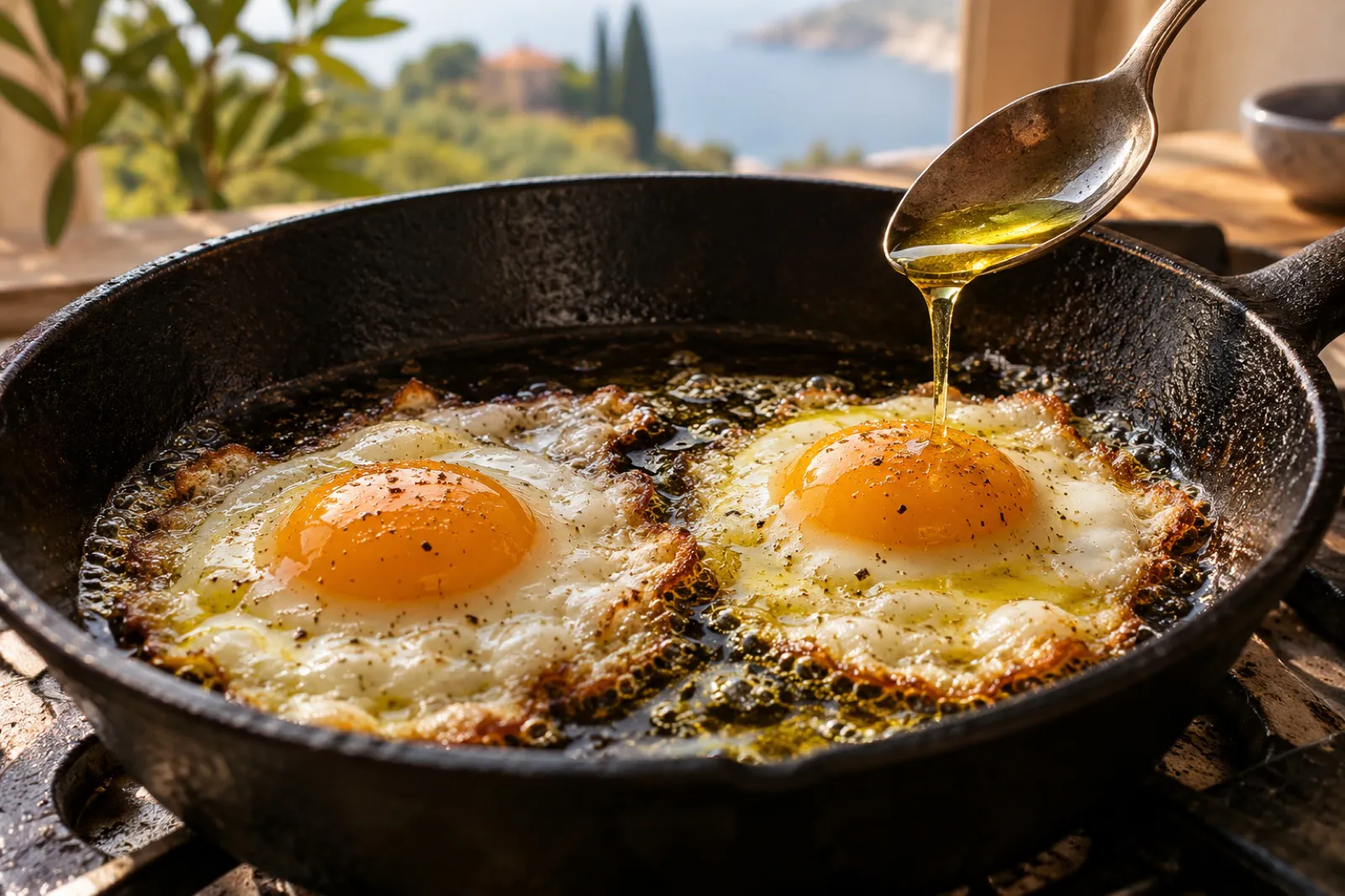
There are two kinds of fried egg. One is cooked gently in a little butter or oil, with soft white edges and no colour. The other is cooked fast in a generous pool of hot olive oil, and comes out with puffed whites, crisp golden lace around the edges and a runny yolk. This is about the second kind.
It takes about two minutes and one small pan. It is one of the best ways to eat an egg.
Crisp-edged fried eggs
Serves 1.
- 2 eggs
- 3 tbsp extra virgin olive oil
- Flaky sea salt and black pepper
- Optional: a pinch of chilli flakes or dried oregano
- Crack each egg into a small cup or bowl. This lets you slide it into the pan quickly and fish out any shell.
- Pour the oil into a small frying pan, about 20 to 24 cm across, and set it over medium-high heat.
- Heat the oil until it shimmers and flows easily when you tilt the pan. To test, drip in a tiny bit of egg white: it should sizzle and bubble straight away. If the oil starts to smoke, it is too hot. Take the pan off the heat for a moment before carrying on.
- Slide the eggs in gently. Stand back a little, as they will spit.
- Let them cook for about 30 seconds, until the edges start to bubble and brown.
- Tilt the pan slightly so the oil pools at one side. Use a spoon to scoop up the hot oil and pour it over the whites, especially the thick part around the yolk. Avoid the yolk itself if you want it to stay bright and runny.
- Keep basting for another 1 to 2 minutes, until the whites are set all the way through and the edges are deep golden and crisp.
- Lift the eggs out with a slotted spatula, letting excess oil drip back into the pan. Season with salt and pepper.
Why the edges go crisp
Egg white is mostly water, with protein mixed through it. When it hits hot oil, a few things happen very quickly.
The water turns to steam. The thin outer part of the white spreads out across the pan into a very thin layer. The oil is far hotter than the boiling point of water, so the water in that thin layer boils off almost instantly. That is the sizzle and the spitting you hear.
Bubbles make lace. As the steam escapes, it pushes up little bubbles through the setting white. Those bubbles are what give the edges their lacy, frilly look.
Dry protein browns. Once the water is gone, the protein left behind is in direct contact with hot oil. It starts to brown and turns crisp, the same browning that gives toast and roasted food their colour and flavour.
The yolk is protected. The yolk sits higher in the pan and is surrounded by thick white, which takes longer to heat. So the edges can go crisp while the yolk stays soft.
Why baste
The underside of the egg is in the oil, so it cooks fast. The top is exposed to the air, so without help, you end up with a crisp base and a raw, wobbly top. Spooning hot oil over the white cooks it from above, puffs it up, and sets it before the bottom overcooks.
Why a small pan and plenty of oil
A small pan lets you use a modest amount of oil and still have it deep enough to pool and baste with. In a large pan, 3 tbsp spreads out into a thin film and there is nothing to spoon.
Using enough oil is the point. With only a smear in the pan, the egg sticks and browns unevenly. With a proper pool, the oil surrounds the edges and fries them evenly.
Staying safe at the stove
- Make sure the pan is completely dry before the oil goes in. Water in hot oil spits hard.
- Slide the eggs in close to the surface of the oil, rather than dropping them from a height.
- Never leave hot oil unattended.
What to do with the oil left in the pan
Do not waste it. Pour it over the eggs on the plate, or tip it onto a slice of toast. It has taken on a little egg and pepper flavour and is very good mopped up.
Ways to serve
On thick toast rubbed with garlic, over a bowl of lentils or white beans, on leftover rice or roast vegetables, or next to sliced tomatoes with salt and a pour of raw olive oil.
If you prefer soft edges
Use medium-low heat and 1 tbsp of oil. Cover the pan with a lid for the last minute so the top sets in the steam. You will get a tender, white, uncoloured egg. Both versions are right. They are just different eggs.
Extra virgin olive oil is widely used for everyday cooking like this, and a fried egg is one of the dishes where it really earns its place. Ours comes from Dukat, in Vlorë county, Albania. Keep a bottle by the stove for exactly this.