
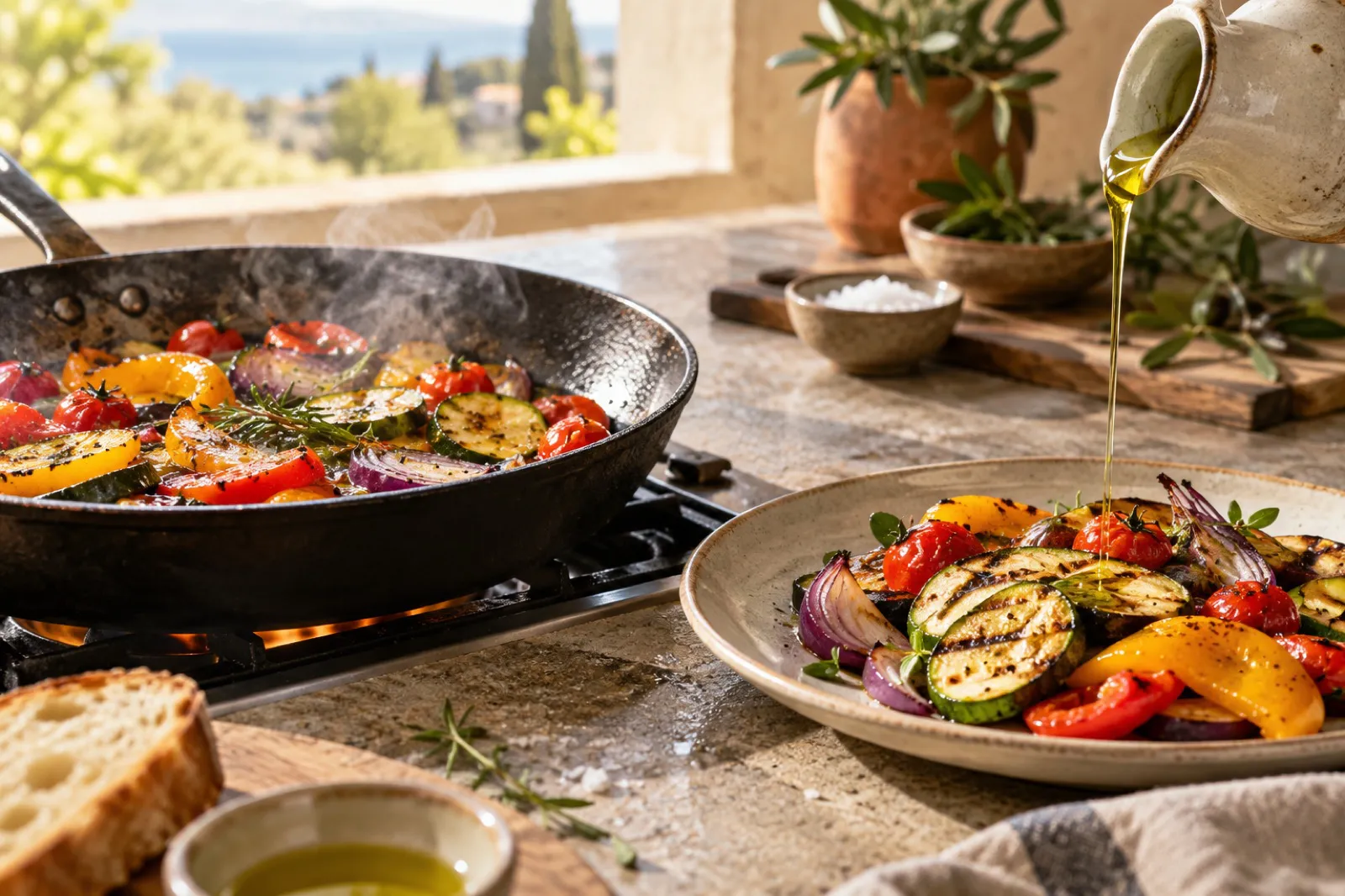
There are two ways to use a bottle of extra virgin olive oil. You can cook with it: in the pan, on the roasting tray, under the vegetables. Or you can finish with it: a pour over the plate just before it goes to the table. Both are right. They do different jobs, and knowing which job you are asking for changes how much you use and when you add it.
What cooking with olive oil does
When oil goes into a hot pan, its job is mostly practical. It carries heat into the food, stops things sticking, and helps the surface brown. Onions soften in it. Potatoes crisp in it. Garlic turns golden and sweet in it.
Extra virgin olive oil is widely used for this kind of everyday cooking, including sautéing, shallow frying and roasting. Cooks around the Mediterranean have done it for a very long time, and there is no reason to save it only for salads.
What heat does change is flavour. The fresh, green, sometimes peppery notes you taste in a spoonful of raw oil soften as it cooks. The oil still brings something, a rounder, fruitier background to a sauce or a tray of vegetables, but the loudest parts of its character fade.
What finishing with olive oil does
Finishing is where you actually taste the oil. A spoonful over a bowl of soup, a thread across grilled fish, a small pool on a plate of beans. Nothing happens to it on the way, so whatever is in the bottle reaches your mouth as it is.
A finishing pour does three things:
- It adds flavour. Grassy, fruity, bitter or peppery, depending on the oil.
- It adds richness. A lean dish, like lentils or steamed greens, feels fuller with a spoonful on top.
- It adds shine. Food looks more like food. It sounds small. It is not.
How to tell which one a dish needs
Ask one question: is the oil there to help cook, or there to be tasted?
If it is helping cook, use what the pan needs and no more. A thin film for sautéing. Enough to coat for roasting. You do not need to flood the pan.
If it is there to be tasted, add it at the end, off the heat, and be generous. This is the step most home cooks skip, and it is the one that makes a plate taste finished.
Plenty of dishes want both. A pan of white beans gets started in oil with garlic and rosemary, then gets a fresh pour when it reaches the bowl. Roast vegetables come out of the oven and get a little more oil and salt before serving. Pasta with garlic and oil uses oil as the sauce, then a final spoonful goes on top.
A few dishes, sorted
Mostly cooking: fried eggs, sautéed onions for a base, roast potatoes, shallow-fried courgettes, a tomato sauce in its early stages.
Mostly finishing: bread for dipping, sliced tomatoes, fresh cheese, hummus, bean soups, grilled fish, steamed greens.
Both: braised beans, roasted vegetables, aglio e olio, minestrone, slow-cooked chickpeas.
Should you keep two different oils?
Some people keep a cheaper oil for cooking and a better one for the table. That makes sense if you cook in large amounts on a tight budget. Deep frying in particular uses a lot of oil, and that is where most people reach for something less expensive.
For everyday cooking, though, one good extra virgin olive oil does both jobs well. The amounts in a frying pan are small. What you gain by using the good bottle is that everything you cook tastes a little more like itself, and you never have to stop and think about which bottle to grab.
The simpler habit: keep one bottle by the stove and one on the table. Same oil, two places. The one by the stove gets used without ceremony. The one on the table reminds you to finish.
Keep it where it lasts
However you use it, olive oil keeps best away from heat and light. The shelf right above the hob is the worst spot in most kitchens, even if it is the handiest. A cupboard nearby is better. Close the cap after each pour, and use the bottle up rather than saving it for an occasion. Olive oil is not wine. It does not improve with age.
The short version
- Cook with it freely. Extra virgin olive oil is a working kitchen oil.
- Finish with it generously. That is when you taste what you paid for.
- Add the finishing pour off the heat, at the last moment.
- Use it up. A bottle saved for a special occasion only loses its freshness while it waits.
Our extra virgin olive oil comes from Dukat, a village in Vlorë county, Albania, between the mountains and the sea. It comes in half-litre bottles, and The Pair suits exactly this habit: one by the stove, one on the table.