

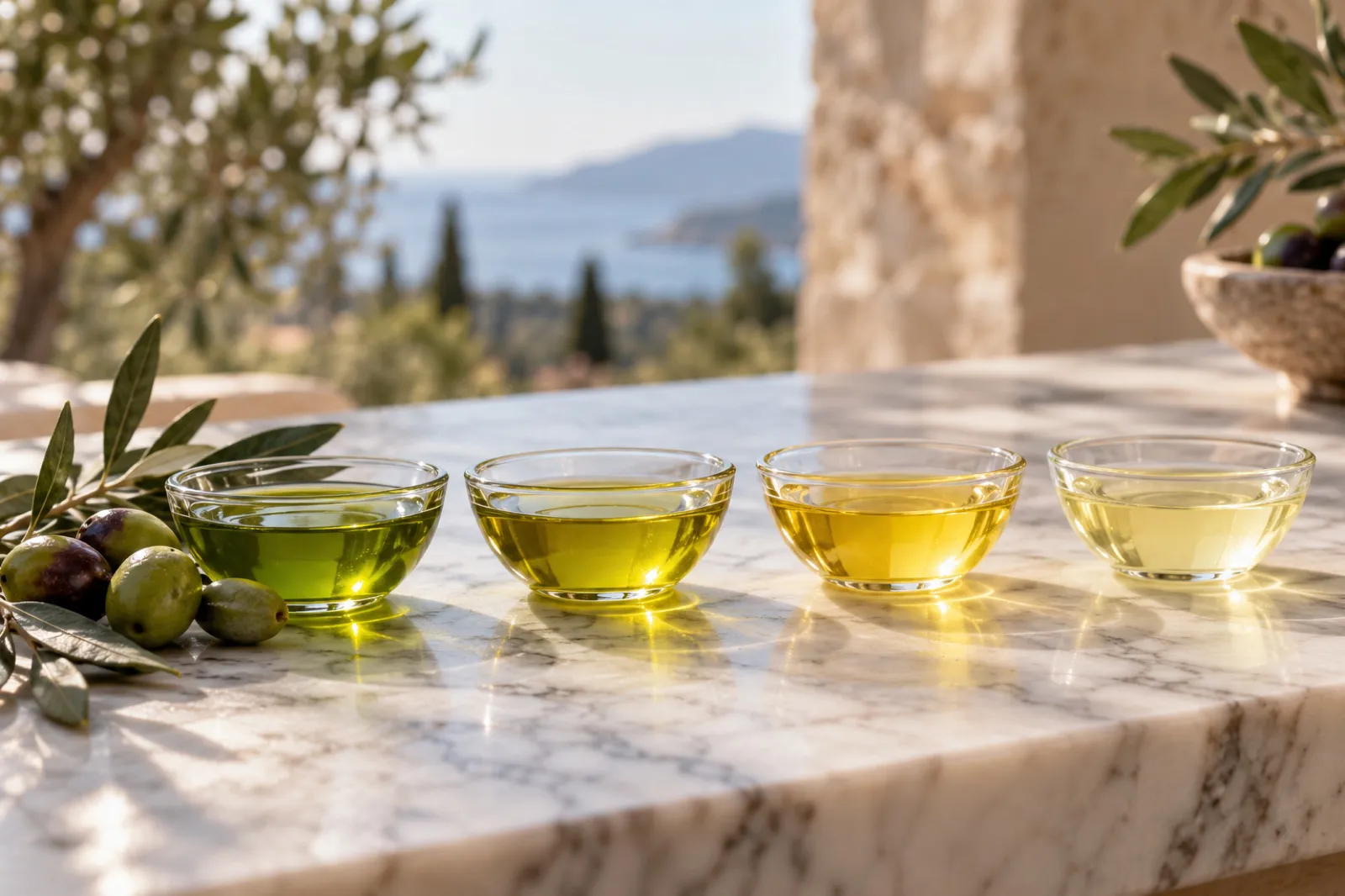
Olive oil is not one product. It is a family of grades, each with its own legal name, and they taste, cook and cost very differently. The names are similar enough to be confusing. Here is the whole family, from the top down.
Extra virgin olive oil
The top grade. It is made from olives by mechanical or physical means only, under conditions that do not alter the oil: the fruit is crushed and the oil separated, with no chemical solvents and no refining. It must pass lab tests, including free acidity at or below 0.8%, and a trained tasting panel must find some fruitiness and no defects (a median defect score of zero).
Tastes like: olives. Depending on the fruit and the harvest, anything from soft and buttery to green, bitter and peppery.
Use it for: everything you want to taste. Bread, salads, soups, beans, grilled vegetables, fish. It works for everyday cooking too: softening onions, roasting vegetables, frying an egg.
Virgin olive oil
Also mechanical only, with no refining. It is allowed higher acidity, up to 2%, and slight sensory defects, but it must still show some fruitiness. It is much less common in UK shops than extra virgin. When you do find it, expect it to be a little less vivid.
Use it for: everyday cooking, if you find one that smells clean.
Lampante olive oil
Technically a virgin oil too, made by the same mechanical process, but one that fails the standards above, with high acidity or clear defects. The name comes from its old use as lamp oil. It cannot be sold to shoppers as it is. It goes to a refinery, which is where the next grades begin.
Refined olive oil
Refining strips out faults along with most of the colour, smell and taste, through processes such as neutralising, bleaching and deodorising. What comes out is close to neutral. Refined olive oil is not sold to shoppers on its own in the UK or the EU. It is the base for the next grade.
Olive oil (refined plus virgin)
This is the bottle labelled simply “olive oil”. Its full legal name is “olive oil composed of refined olive oils and virgin olive oils”. The law does not fix the proportions, but it is typically mostly refined oil, with some virgin or extra virgin oil added for a little flavour and colour. Bottles sold as “pure”, “classic”, “mild” or “light” are usually this grade.
Tastes like: not much. That is the point.
Use it for: cooking where you do not want olive flavour. It is a different product from extra virgin, not a cheaper version of the same thing.
Olive-pomace oil
Pomace is what is left after the oil is extracted: skins, pulp, stones and water. There is still a little oil in it, which is recovered with solvents, then refined and blended with some virgin oil. The result is sold as olive-pomace oil. In the UK and the EU it can never be called simply “olive oil”.
Use it for: neutral, low-cost cooking. If you see “pomace” on a label, you are not buying anything close to extra virgin.
The four you can actually buy
In UK and EU shops, olive oil sold to consumers must be one of four grades:
- Extra virgin olive oil
- Virgin olive oil
- Olive oil composed of refined olive oils and virgin olive oils
- Olive-pomace oil
Anything else on the front, such as “premium”, “pure” or “first press”, is not a grade. Look for one of these four names. It is often in smaller type than the brand.
A note on “light”
“Light” olive oil causes a lot of confusion. The word describes the colour and flavour, which are pale and mild because the oil is mostly refined. It is a style of the third grade above, not a separate category, and it says nothing about quality.
Which grade should you buy?
For anything where you will taste the oil, buy extra virgin, and buy it fresh. The grade alone is not enough. An extra virgin that has spent a year in clear glass under shop lights can taste far worse than its label suggests. Look for a harvest date, a clear origin and dark packaging as well.
If you also want a neutral oil for some jobs, buy one separately and pay less for it. That is better value than paying extra virgin prices for a blend, or using your best bottle where nobody will taste it.
Dukat oil is extra virgin, from Dukat, a village in Vlorë county, Albania, in dark glass, with a harvest date and a batch code on every bottle. Shop the oil if you want to taste the top of the family.