

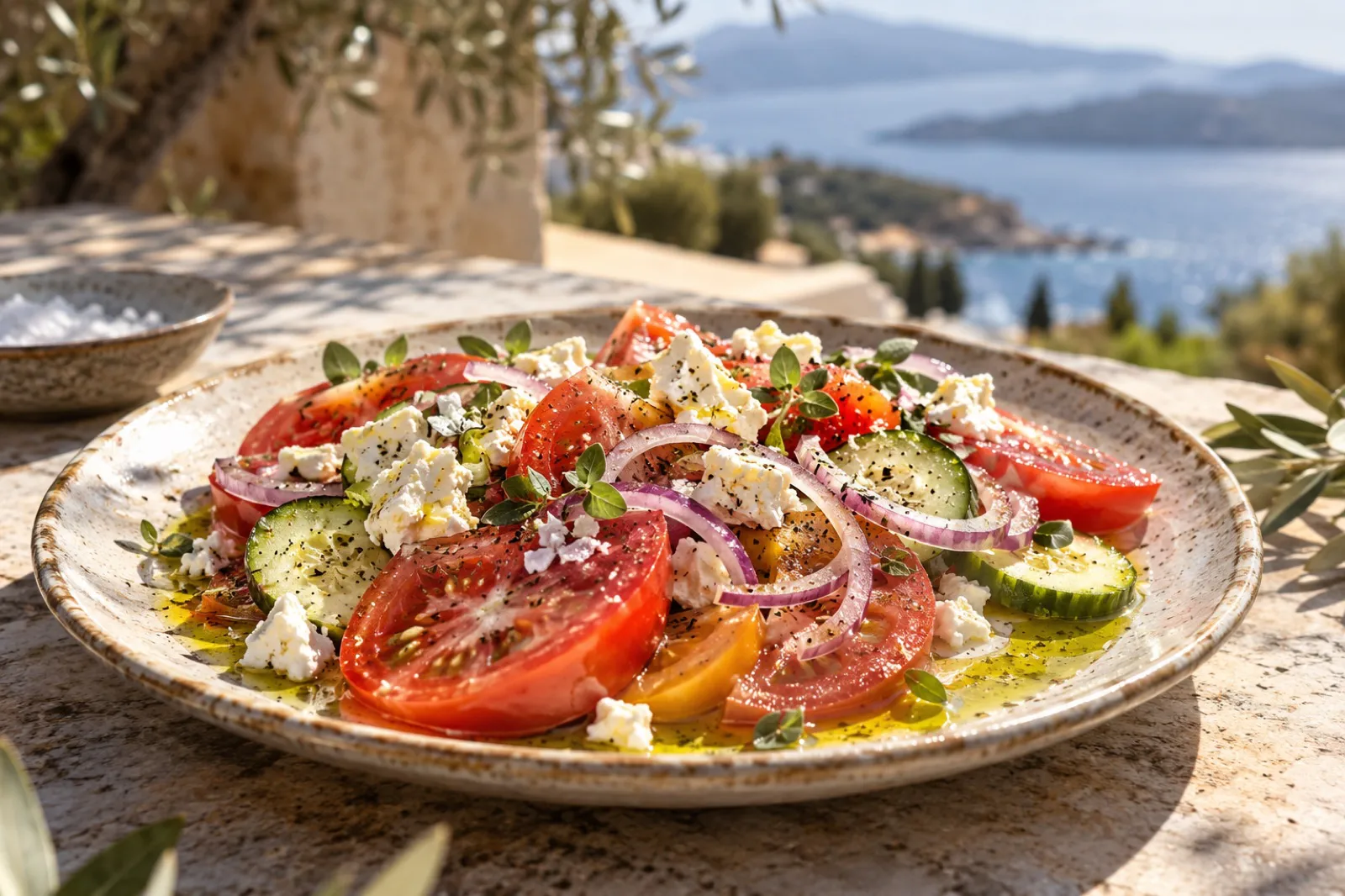
A tomato salad is not really a recipe. It is a handful of decisions: which tomatoes, how to cut them, how much salt, how much oil, and whether to add anything else. Get those right and you have one of the best things you can eat in summer. Get them wrong and you have a plate of watery, cold slices.
Here is how to think about each decision, so you can make it your own way every time.
Start with the tomatoes
Everything depends on this. A salad this simple cannot rescue a pale, hard tomato.
- Buy ripe. A ripe tomato smells of tomato at the stem end, feels heavy for its size, and gives slightly when you press it.
- Buy in season. High summer into early autumn is when tomatoes taste most like themselves in most of Europe.
- Mix them up. Different sizes and colours look good together and taste slightly different. Large ones, cherry tomatoes, plum tomatoes, whatever looks best.
- Keep them out of the fridge. Cold dulls their flavour and makes the texture mealy. Store them at room temperature and eat them within a few days.
Cut them in more than one way
Thick slices of large tomatoes, wedges of medium ones, halves of cherry tomatoes. Mixing the cuts gives the salad different textures and means more cut surfaces for the salt to work on. Use a sharp or serrated knife so you slice cleanly rather than crushing them.
Salt first, then wait
This is the step that matters most. Spread the cut tomatoes on a wide plate and salt them evenly, a little more than you think. Then leave them for 10 to 15 minutes.
The salt draws out the juices and seasons the tomatoes all the way through. Those juices pool on the plate and become half of your dressing. Flaky salt is nice for crunch, but any salt will do the job.
Then the oil
Pour olive oil over the tomatoes just before serving. Be generous: the oil mixes with the tomato juices into a light, rich dressing at the bottom of the plate, and you want enough to mop up with bread.
This is a raw dish, so you taste the oil exactly as it is. A fresh, green or fruity extra virgin olive oil makes the tomatoes taste sweeter and brighter. A tired oil makes them taste of very little. If you have been saving a good bottle, this is the dish to open it for.
Acid, if you need it
Really ripe tomatoes often have enough sharpness of their own. Taste one after salting. If it seems flat, add a small splash of red wine vinegar or a squeeze of lemon. A little goes a long way, and too much will cover up the tomatoes.
Anything else is optional
Pick one or two of these, not all of them. The tomatoes should still be the point.
- Onion: thinly sliced red onion or shallot. Soak it in cold water for 10 minutes first to soften its bite.
- Herbs: torn basil, dried or fresh oregano, mint, parsley or dill.
- Cucumber: in thick half moons, for crunch.
- Cheese: crumbled feta, torn mozzarella or a few shavings of a hard cheese.
- Bread: chunks of stale bread tossed in, to soak up the juices.
- Something salty: a few olives or capers.
- Heat: a pinch of chilli flakes or a few slices of fresh chilli.
Across the Balkans, including Albania, a plate of tomato, cucumber and onion with white cheese and olive oil is a familiar sight on the summer table. It is a good model to follow: a few honest ingredients, each one ripe, nothing to hide behind.
Putting it together
For two people as a side, roughly:
- Cut about 500 g of mixed ripe tomatoes and spread them on a wide plate.
- Salt them well and leave for 10 to 15 minutes.
- Add any extras you are using.
- Pour over 3 to 4 tbsp extra virgin olive oil, add a few turns of black pepper, and taste.
- Adjust with more salt, a drop of vinegar or more oil, and serve straight away with bread.
Serve it at room temperature
Do not chill a tomato salad. It tastes best at room temperature, within half an hour of making it. Left longer, the tomatoes soften and give up too much liquid. If there is any left, spoon the juices and oil over toast, stir them into cooked beans, or toss them through warm pasta the next day.
And always serve bread. The best part of a tomato salad is often what is left on the plate.
Our extra virgin olive oil comes from Dukat, a village in Vlorë county, Albania, between the mountains and the sea. Tomato season is short, so make the most of it, and keep a bottle on the table while it lasts.