

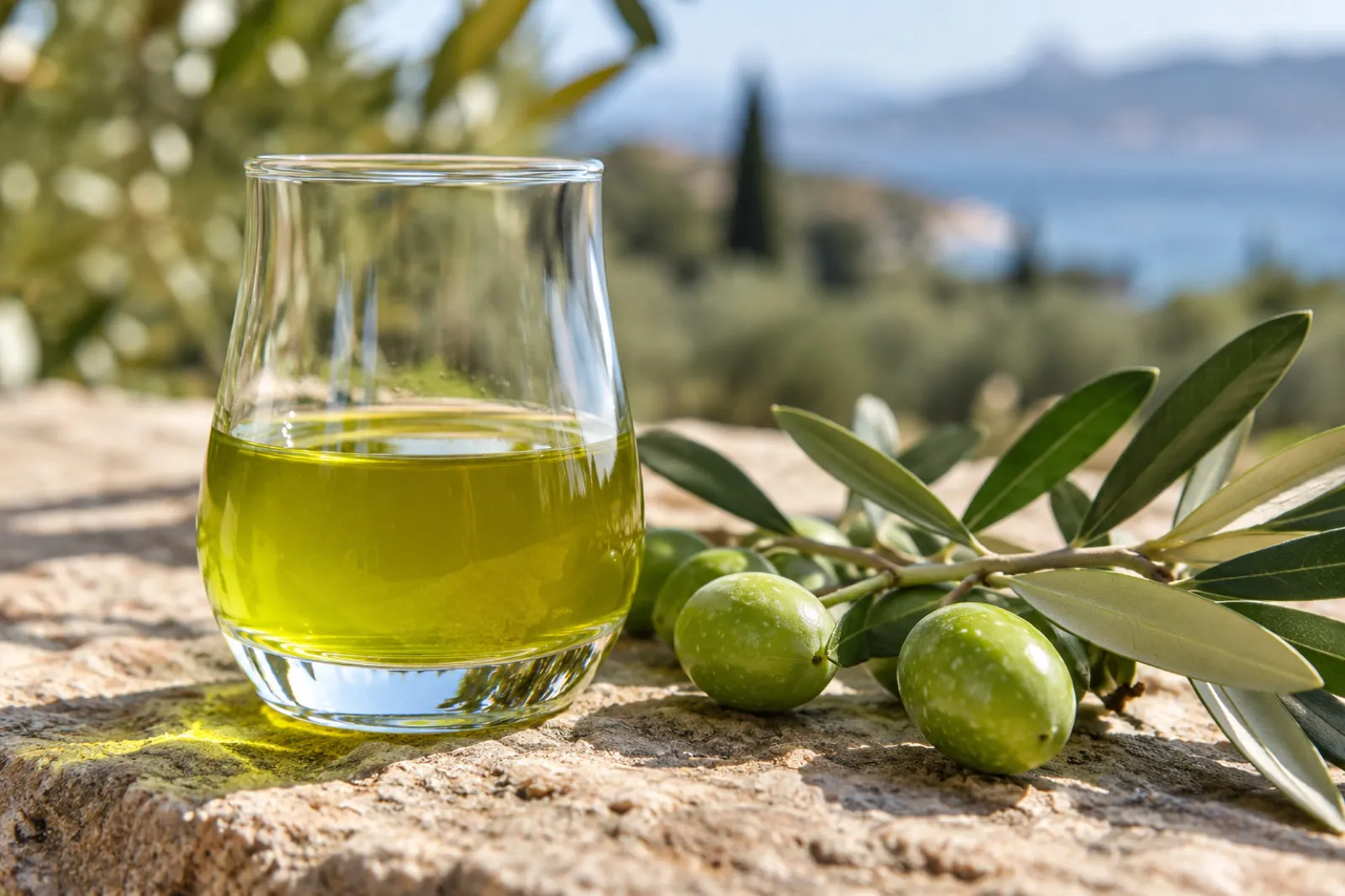
The first time many people taste a really fresh extra virgin olive oil, they are surprised. It is bitter. It burns the back of the throat. Sometimes it makes them cough.
A common reaction is to assume something is wrong. Usually, the opposite is true.
What professional tasters look for
Extra virgin olive oil is graded partly by chemistry and partly by a trained tasting panel. The panel looks for defects and for three positive attributes:
- Fruitiness. The smell and taste of sound, fresh olives. Green fruitiness is grassy and leafy. Ripe fruitiness is softer, with notes like apple, almond, or banana.
- Bitterness. Felt on the tongue, like rocket, chicory, or unripe walnut.
- Pungency. The peppery sting at the back of the throat.
All three are considered good. An oil with no defects and some fruitiness can be extra virgin. An oil with fruitiness, bitterness, and pungency in balance is what many tasters get excited about.
Where the bitterness comes from
Bitterness and pepper come largely from polyphenols, a family of natural compounds in olives. Raw olives are so full of them that they are inedible until cured. Some of these compounds carry over into the oil when the olives are crushed.
The amount depends on a few things:
- Ripeness. Olives picked greener give a more bitter, peppery oil. Riper olives give a softer oil.
- Variety. Some olive varieties are naturally bolder than others.
- Speed and care. Olives milled quickly after picking keep more of their character.
- Age. Bitterness and pepper fade as an oil gets older.
That last point is why bitterness is such a useful signal. It tells you something about freshness.
Bitterness is a freshness check
Olive oil does not improve with age. From the day it is made, it slowly loses its aroma, its bitterness, and its pepper. Light, heat, and air speed that up.
So an oil that is still bitter and peppery is, very often, an oil that has not been sitting around for long or has been stored well. An oil that tastes of nothing much, or tastes waxy, or smells like crayons or old nuts, has gone the other way.
It is not a perfect test. Some excellent oils are made to be mild, from ripe olives, and are meant to taste gentle. But if an oil is labelled as robust or intense and has no bite at all, it has probably lost what it once had.
How to taste olive oil at home
You do not need a panel. You need a small glass or a spoon.
- Pour a little oil into a small glass. Cup it in your hand to warm it slightly, with your other hand over the top.
- Uncover and smell. Look for grass, green leaves, tomato vine, artichoke, apple, or almond.
- Take a small sip. Draw in some air through your teeth so the oil spreads across your mouth.
- Notice the bitterness on your tongue.
- Swallow, and wait for the pepper at the back of your throat.
If you cough, that is a compliment to the oil. Tasters sometimes describe oils by how many coughs they get.
Learning to enjoy it
Bitterness is an acquired taste, like coffee, dark chocolate, or a hoppy beer. On a spoon, a bold oil can feel like a lot. In food it behaves differently.
- On a warm potato or a bowl of beans, bitterness softens and the fruit comes forward.
- With tomatoes, the acid and the bitterness balance each other.
- Over grilled meat or fish, the pepper cuts through richness.
- On bitter leaves, a bold oil makes sense. Like goes with like.
Give it a week of using a peppery oil on everything, and a mild oil may start to taste a little empty.
What bitterness does not tell you
We want to be clear here. Bitterness is about taste and freshness. It is not proof of any particular content or any health benefit, and a bitter taste is not a reason to expect anything other than a better meal. The only way to know what is actually in an oil is a lab test.
Taste it for yourself
The best way to understand all this is to taste two oils side by side: a supermarket bottle that has been on the shelf a while, and a fresh one. The difference is usually obvious in the first sip.
Our extra virgin olive oil comes from Dukat, in Vlorë, Albania, and every 0.5 L bottle carries its harvest date, so you can match what you taste to how fresh it is. Pour some in a glass and try the steps above. If you would like a bottle to start with, you can find our oil here.