

Olive oil collects myths the way a kitchen collects jars. Some come from old advice, some from marketing, and some just sound right. Here are eight we hear often, and what is actually true.
Myth 1: You should not cook with extra virgin olive oil
This is the most common one, and it is wrong. Extra virgin olive oil has been the everyday cooking fat across the Mediterranean for a very long time. People fry eggs in it, roast vegetables in it, and start almost every stew and sauce with it.
It is a practical choice for normal home cooking, from gentle sautéing to roasting and shallow frying. The main reason to save your best oil for finishing is flavour. Heat softens the delicate aromas, so a raw pour at the end is where you taste the oil most clearly.
Myth 2: Heating olive oil ruins it
Heat changes olive oil, as it changes every food. The fresh, grassy aromas fade in a hot pan. What remains is still a good cooking fat that adds richness and helps food brown.
Use common sense. Do not let any oil smoke heavily in the pan. If it does, turn down the heat, wipe the pan, and start again.
Myth 3: Greener oil is better oil
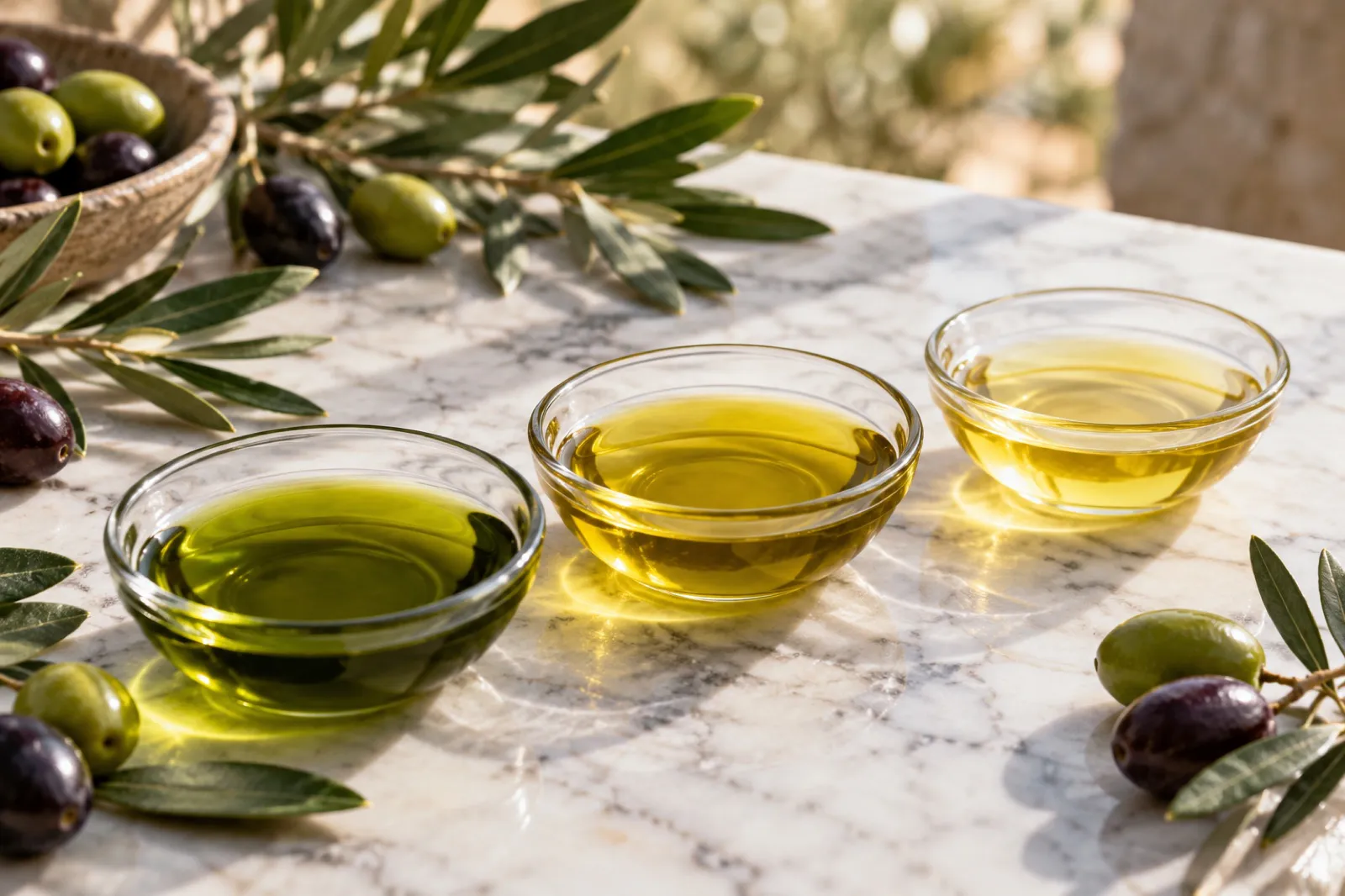
Colour tells you very little about quality. The green comes from pigments such as chlorophyll, and the amount depends on the olive variety and how ripe the olives were when picked. Gold oils can be excellent. Green oils can be poor.
Professional tasters judge olive oil in dark blue glasses precisely so the colour does not influence them. Trust your nose and your tongue instead.
Myth 4: “Light” olive oil has fewer calories
“Light” or “extra light” on an olive oil bottle refers to flavour and colour. These oils are usually refined, so they taste of very little. They carry the same energy as any other oil: roughly 120 kcal per tablespoon.
If you want a mild oil for baking, a light olive oil works. Just know what the word means.
Myth 5: Expensive always means good
Price is not a guarantee. A beautiful bottle and a high price can hide an oil that is old or badly stored. Good questions to ask are:
- Does it say extra virgin?
- Is there a harvest date, or at least a best before date far enough away?
- Is it in dark glass or a tin, which protect it from light better than clear glass?
- Can the seller tell you where it comes from?
That said, the reverse is also true. Making good extra virgin olive oil takes careful farming and quick milling, and that costs money. If a bottle is far cheaper than everything else on the shelf, it is fair to ask why.
Myth 6: “First cold pressed” means special
This phrase sounds traditional, but it describes something most modern oil does not go through. Today, most olive oil is extracted with machines that crush the olives into a paste and separate the oil by spinning, not by pressing. There is usually only one extraction, so “first” does not tell you much.
Both phrases are controlled in GB labelling rules. “First cold pressing” may only be used for oil made below 27°C in a first mechanical pressing with a traditional press. “Cold extraction” may only be used for oil made below 27°C by percolation or centrifuging. Centrifuging is how most oil is made today. But the term that matters most is extra virgin, which is a defined grade with chemical and tasting standards behind it.
Myth 7: Olive oil gets better with age
Unlike some wines, olive oil does not improve in the bottle. It is at its liveliest soon after it is made and slowly declines from there. Once opened, air speeds things up.
Buy a size you will finish in a reasonable time, store it somewhere cool and dark, and keep the cap on. Do not save a good bottle for a special occasion. Use it.
Myth 8: Cloudy oil has gone bad
If olive oil gets cold, for example in a chilly kitchen or the fridge, it can turn cloudy or form white flecks. That is just the oil starting to solidify. Bring it back to room temperature and it clears.
Some fresh, unfiltered oils are naturally a little cloudy too. To tell if oil has actually gone off, smell it. Rancid oil smells of crayons, putty, or stale nuts.
A note on health myths
You may have noticed we have not covered the health promises you see online. That is deliberate. In Great Britain, food businesses may only make health claims that are on an authorised register, in approved wording, and only when the food meets the conditions. Most of what circulates about olive oil is not on that register. We would rather not add to the noise.
The short version
Cook with it. Finish with it. Ignore the colour. Read the label, not the price tag. Use it while it is fresh.
Our extra virgin olive oil comes from Dukat, in Vlorë, Albania, in 0.5 L dark glass bottles with the harvest date and batch code on each one. That answers all four questions in Myth 5 before you open it. If you would like to try it, you can find our oil here.